Enchilada Recipe
Filling Ingredients:
2 lbs meat, 1 can of beans, 1 15 oz jar of salsa, 1 8 oz block of cream cheese, 1-2 onions (depending on size), 1 bell pepper or 3-4 jalapenos, 4 cloves of garlic, 1 tbsp cumin, 1 tbsp salt
Filling Instructions:
Fry onions. After 10 minutes, add peppers. After 10 more minutes, add all remaining ingredients. Cook until cream cheese is fully melted and incorporated. Meat does not need to be fully cooked at this stage because it will be baked later.
Sauce ingredients:
1/4 cup oil, 2 tbsp chili powder, 1 can tomato sauce, olives to taste.
Sauce Instructions:
Heat oil until just starting to shimmer, reduce heat to med-low. Add chili powder, and cook 3 minutes. Add sauce and cook another 2 minutes. Add olives and remove from heat.
Assembly:
Preheat oven to 350. Grease a large baking pan. Add filling to 6-8 tortillas and place them in the pan (one at a time). Spread the sauce evenly across the top. Add 1 cup of shredded cheese on top of the sauce. Bake for 30 minute. You can broil it a bit at the end if you want browned cheese.
Commentary: The two things really driving this recipe are 1.) Frying the chili powder in oil. It makes the flavor really intensify. You can use fancier chili powders or even grind your own dried peppers to really take it to the next level. 2.) The cream cheese in the filling, which really adds a lot of richness and cheese flavor. If you like sour flavors, add a whole can of olives to the top. In my opinion the taste combination of spicy + cheesy + sour + umami from meat and beans is amazing. You can also add various vegetables to make it a bit healthier, but this is not a low calorie recipe, so don’t bother if that’s what you’re looking for.
Full ingredient list for shopping:
2 lbs meat and/or beans, 1 15 oz jar of salsa, 1 8 oz block of cream cheese, 1-2 onions (depending on size), 1 bell pepper or 3-4 jalapenos, 4 cloves of garlic, 1 tbsp cumin, 1 tbsp salt, 1/4 cup oil, 2 tbsp chili powder, 1 can tomato sauce, olives, 1 cup cheese, 6-8 tortillas.
Why Ukraine is not Iraq
I always opposed the war in Iraq, which I have written many articles about in the past. I support the U.S. killing Osama Bin Laden. If someone attacks a country, you should expect a counterattack. I also don’t mind assassinations for the same reason. If America developed a reputation as an actor who just killed dictators and terrorists that didn’t play nice, that would cause those dictators and terrorists to think twice before acting against us in a way that doesn’t cause massive casualties and would be far cheaper than full scale invasion. The dream of neocons was to change Iraq into a fundamentally different place where the people didn’t have to live under an awful dictator and could be a U.S. aligned democracy. Iraq is a better place now than under Saddam Hussein, but at a huge cost in both lives and money, and how stable it will be in 50 year’s time remains to be seen.
Despite many people drawing attention to parallels between them, Ukraine is a very different situation. First, the aggressor in the Iraq war was America, whereas in Ukraine, it’s Russia. I believe defending yourself from attack, both personally and in international affairs, is inherently morally good, whereas starting a war requires a clear and compelling justification. Russia has a pattern of deliberately committing war crimes and targeting civilians to cause terror. It usually backfires historically, and certainly has in this conflict. After Bucha, the Ukrainians were never going to stop fighting and accede to a Russian takeover. The only options from their point of view is either to fight or to die. It’s the same problem Hitler had in the Soviet Union – once the people realized he was just there to slaughter them, no matter how much they hated Stalin, or how incompetent the Red Army generals were, the populace didn’t have a choice but to fight to the death.
https://www.statista.com/chart/27331/countries-committing-the-most-of-their-gdp-to-ukraine-aid/
Although the U.S. has provided most of the aid so far, in terms of aid per capita, it’s in the second tier of supporters with the U.K., after the former USSR countries like the Balkans and Poland, who know what it’s like to live under Russian rule and have far higher willingness to help Ukraine no matter what. Given all this, if you want a short war, you should want Ukraine to win quickly.
America’s military is designed to fight a war against Russia and China simultaneously. The Military Industrial Complex (MIC) has a life of its own at this point, but in a nutshell, that’s the goal. The less we have to worry about Russia, the more we can either cut spending or focus on deterring China. If you want to shrink the size of the MIC, the best way to do that is to eliminate Russia as a threat and convince China to back down from their arms race. There was a peace dividend after the fall of the Berlin Wall, and hopefully there can be one again now that the Global War on Terror (GWOT) is over and Russia is humbled.
America’s support for Ukraine does not cost anywhere near as much as the GWOT. The nominal cost of Ukraine support is in the neighborhood of 5% of the DoD budget. Furthermore, the sorts of things we’re sending over are not costly to the taxpayer now, they are things that cost the taxpayer money 20 or 30 years ago.

America has a stockpile of old weapons, many of which are obsolete. We pay to keep these weapons stored and in decent condition so that if there were ever a land war in Europe, we’d have tens of thousands of tanks ready to go. Well, there’s a land war in Europe now, we might as well use them.
Vehicles sent to Ukraine:
MRAPs – obsolete, not useful for anything other than security in a counterinsurgency environment
HMMV – obsolete (JLTV)
M113 – Obsolete since like 1980
Striker – Obsolete
HIMARS – really old, already considered to be replaced. ATACMs is obsolete and hasn’t been produced since 1997
M105 Paladin – Outdated, certainly 2nd tier compared to panzerhaubitze 2000 or other modern SPGs
Javelins – Old, cheap, and very cost effective
Stinger – obsolete, long in need of replacement
F-16 – Nearly obsolete, 1972 era tech, basically only good for ground attack now and we’ve replacing everything with F-35s
Munitions have an expiration date. If we were just going to throw them out anyway, we might as well give them to Ukraine. Much of the equipment in the U.S. arsenal is designed either to fight the U.S.S.R. or the GWOT and won’t be that helpful against China. In conclusion, yes, it would be nice if the U.S. hadn’t spent trillions of dollars accumulating huge stockpiles of weapons and instead either had lower taxes or spent the money on things that improved people’s lives, but given that we do have huge stockpiles of weapons, we might as well give them to countries that are defending themselves from evil totalitarian regimes.
A Proposal for Coin Reform
Coins’ value is far too low for how costly they are to produce and ease of use. If you actually tried to use coins to buy something, you’d have to carry around several pounds worth of coins, which would be uncomfortable and difficult. This has been true for a long time, but the higher inflation goes, the more inconvenient and worthless coins become. I have a simple proposal which I believe addresses all of these concerns while keeping coins in circulation.
- All coins should be worth 10 times their current face value. Pennies would be worth 10 cents, quarters $2.50, $1 coins would become $10 coins.
- Stop printing new $1, $5, $10 bills, which would be replaced by coins. Remove $50 bills too because $50 bills are stupid and no one likes them. Seriously, just use a $20 or a $100 weirdo.
- Get rid of the last digit of currency. All prices, etc. are rounded to nearest $0.10. Ten cents today is worth less than a penny was in 1960.
30 Page Introduction to Economics Outline
If I were training someone specifically in anti-trust, I’d spend 20 pages on supply and demand and price theory, 5 pages on Structure Conduct Performance models, and maybe 5 pages on “The Use of Knowledge in Society” by Hayek. This is the core of anti-trust. Firms want to collude to reduce quantity supplied and increase prices. Anti-trust is there to punish them when they do. Emphasize the point is to help consumers, not firms. If you can’t find an actual harm to a consumer from market power, that’s a lower priority for enforcement than firms which are conspiring to raise prices. I would spend at least a page or two talking about how the government can make competition worse through regulation, such as occupational licensing, firm specific subsidies, and trade protectionism.
The second main benefit of anti-trust is to discourage mergers and acquisitions. According to this article by Graham Kelly in the Harvard Business Review, 70-90% of acquisitions fail to be profitable. A KPMG study estimated the figure was at 83%. There are other studies with a variety of estimates, but the consensus is that the vast majority of mergers are unprofitable in addition to reducing competition. Therefore, even if the government stops mergers randomly, it’s still likely that they will improve market efficiency. Perhaps CEOs initiate mergers despite their unprofitability because being the CEO of a larger firm is likely to boost their personal income, despite lower overall profits. Who knows; I’m not a corporate governance expert either, but I find it compelling enough that even stupid justifications for disallowing mergers probably improve the economy.
Without further ado, for the general student, here’s what I’d spend my introduction time on:
History of economic development – Everyone used to be poor, then some countries got really rich really quickly. Industrial revolution + capitalism produced mass wealth in excess of what any kings of the past had access to. Show Gapminder stats – changes in life expectancy, access to appliances, reduction in hours worked, reduction in time spent on chores, etc. Basically impress upon the students how much life has improved in 150 years and how important it is to figure out why and how to do more of it. Spend 5 pages on this.
Some countries are still poor, and it’s really hard to turn a poor country rich. “Division of Labor Is Limited by the Extent of the Market” – Adam Smith. Trade = wealth. No trade = mass poverty. Specialization and exchange become more important as technology advances because production becomes more difficult and more specialized. No one can make a Pencil, by Leonard Read. There are other examples of showing just how difficult modern production is. Someone spent a year trying to make a toaster, someone else spent 6 months making a chicken sandwich, there are several examples in the genre to use, but basically production is really difficult and only specialization and exchange can result in decent living standards. This is 11 pages on it. Maybe a bit long, but it could be cut down. Maybe trim this section to 9 pages.
8 pages – Supply and demand. I wrote a 4 part article that tried to simplify it down to the basics. Let’s say that’s 2 pages per article.
2 pages – Henry Hazlitt’s Economics in One Lesson.
Hayek’s Use of Knowledge in Society – How the economy is an information processing institution. This is probably too advanced for a new student, but it’s super important. Maybe someone could write a dumbed down version. 5 pages.
1 Page on macroeconomics. What is inflation, how it’s caused, why deflation causes unemployment, basic info on what the stock market is, etc.
This is probably honestly closer to 50 pages if I put everything I wanted. Things would have to get cut down, but that’s a first draft of how I would allocate 30 pages to get someone a basic idea of what economics is.
Warframe: Time stop Nekros build
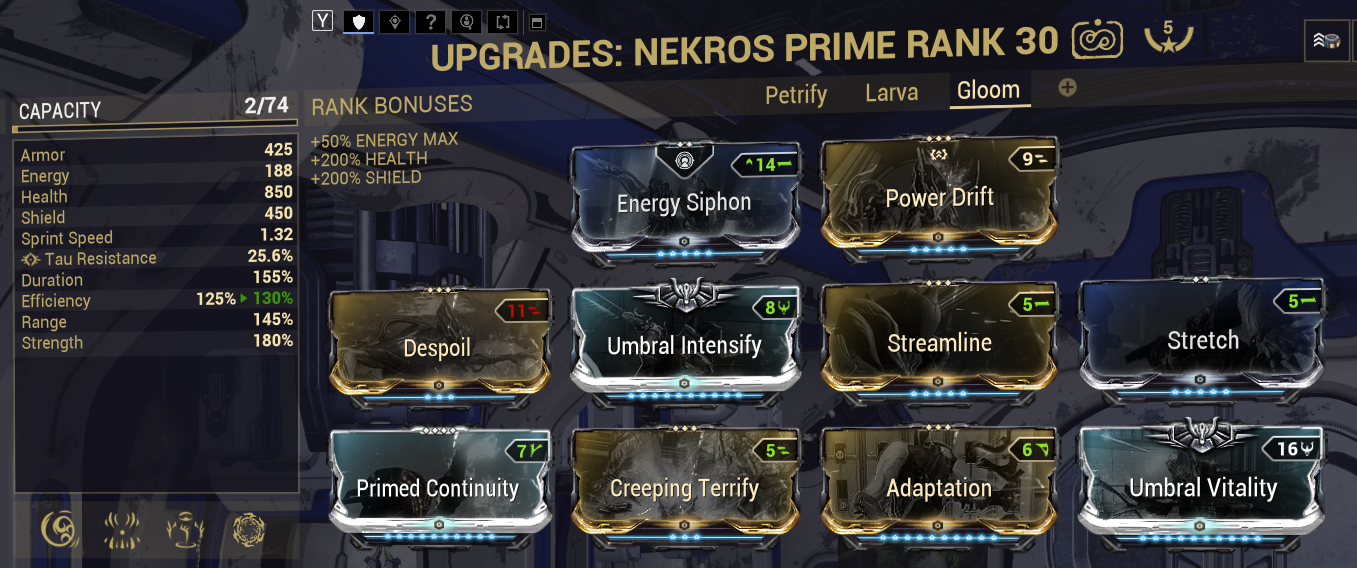
This isn’t a “Steel Path to level cap” kinda build. It’s more for highish level lazy materials farming. You replace Shadows of the Dead with Gloom, which gives Nekros a reliable heal to offset the health loss from Despoil. Use Soul Punch if you want to create shadows instead. I use Umbral Vitality to get more health and power strength. Adaptation also helps with survivability, but you can replace it with whatever durability mods you need. For very high level, I’d recommend Rolling Guard instead.
Terrify gives you 3 things – CC, slow, and armor strip. Full armor strip occurs at 167% power strength, which is why I have Power Drift. Archon Shards are another option to hitting that with only Umbral Intensify. When you stack Creeping Terrify with Gloom, enemies basically stop moving entirely.
The rest of the mods are pretty optional as well. Continuity and Streamline are nice for maintaining energy, but you can use Equilibrium, Primed Flow, Arcane Energize, or Zenurik or whatever. As long as there’s something there to maintain energy. At least some range is required since Terrify, Gloom, and Desecrate all need it. I don’t really like using Overextended because you have to put a lot of other mods on to get the power strength you need back. You can replace Streamline with Auger Reach if you want +75% range.
Note: You could also use Helminth to add Terrify to Nova or Sevagoth to get a similar double slow effect.
The Best Weapons in Warframe (updated)
Starting Weapons
It does not matter much which ones you pick, since you will quickly get better weapons. Personally, I’d go with the MK1 Braton, the MK1 Kunai, and the MK1 Bo, but it’s personal preference. Just sell them as soon as you get replacements.
First Upgrades
The Hek, Karak, Dread, and Ignis are great early game weapons. Once you hit MR 9, get the Ignis Wraith from the Dojo, which is one of the best AOE weapons in the game.
The Sonicor is a very powerful secondary, considering how easy it is to get. At MR 5, the Atomos is an excellent short range weapon that can handle all star chart content.
The Amphis is the best mastery rank 0, non-Prime melee weapon. At MR 2, there is the Scindo, which does good damage and has a large attack radius and is easy to acquire. At MR 5, the Cassowar, avaiable in the Clan Tenno lab, is a big upgrade.
As soon as you can, try to get some Prime weapons. They are almost all good, and if you have some platinum to spend, you should be able to buy some Prime weapons cheap in trading chat. If you join a clan, you’ll gain access to clan weapons, which aren’t top tier, but can help rank up mastery and they have some interesting and fun options.
Primary Weapons
The best explosive/large AOE primaries are the Kuva Zarr and the Kuva Brahmma. Other good options are the Probiscus Cernos, and Bubonico. For single targets, the best option is the Phenmor. You can’t go wrong with pretty much any of the Kuva or Tennet weapons either, or the Phantasma Prime.
For shotguns, the Felarx is the highest damage shotgun, and the Cedo is excellent at applying status effects to multiple enemies quickly, if you want to prime for Condition Overload or Galvanized Aptitude/Savvy/Shot.
Secondary Weapons
For single target DPS, the best pistol is the Laetum Incarnon weapon. For status application, use the Kuva Nukor, which can get over 100% status chance and jumps to multiple enemies, and the Epithaph, which also can do a ton of status, but over an AOE. For AOE damage, the Sporelacer kitgun is pretty good. All kitguns, Kuva, and Tenet weapons are solid choices.
Melee Weapons
The Praedos and Innodem are the pinnacle of melee weapons. The bonuses from their evolutions put them a solid step ahead of all non-Incarnon melee weapons.
Other good melee options include: Zaws, Stropha, Glaive Prime, Venka Prime, Kronen Prime, and the Tenet Grigori.
The Myth of “No Choice”
One pet peeve of mine in regards to history discussion is when a decision made by a leader, which on its face seems to be a major mistake, is presented as that leaders only option. I hear it in regards to Japan quite frequently. Japan had to attack British colonies in the South Pacific and had to attack Pearl Harbor. They simply had “no other choice” because they needed strategic resources. Well, why did they need strategic resources? Because they were in a major land war in China. Why were they in a war against China? Oh, because they FUCKING STARTED IT. If they ran out of resources in 1941, what horrible fate would have befallen Japan? They would have had to negotiate a cease fire with China. Boo frickin’ hoo.
Similarly, but less frequently, you hear about how Hitler had “no choice” but to attack the Soviet Union. Well, why did he have no choice? Because there were Jews and Slavs in the Soviet Union and he couldn’t very well kill all the Jews and Slavs in the world unless he invaded. Ooooooorrrr he could have just not. No one would have attacked Germany had they not rearmed and abided by the Versailles Treaty. Germany in 1942-1945 may have been at the front line of a war against the Soviet Union, but they would have been fighting side by side with the UK, France, and possibly the U.S. instead of against all of them. The problem is, if you take the desires of a dictator as inflexible and worth literally any sacrifice of lives and property to achieve, you’ve already bought into the dictator’s frame of reference of the world (Weltanschauung) and given it priority over reasonable sane ways of looking at the world.
Which brings us to today, and Putin’s invasion of Ukraine. The most absurd justification for Putin’s aggression is geography. The argument goes, “the east of Ukraine is flat and so is eastern Russia, so if Russia doesn’t conquer everything east of the Fulda Gap that leaves them vulnerable to fast Panzer charges across the open plains.” World War 2 is over. No one wants to invade Russia. If Russia had no military at all apart from their nukes, still – no one would want to invade Russia. Maybe maybe maybe if they had no military and no nukes, I could see Georgia and Chechnya getting some kicks in, but how far would they seriously be able to advance? No one invades Denmark, despite it being flat. No one invades literally hundreds of countries around the globe that do not have defensible borders. Sacrificing tens of thousands of lives to move your borders a few miles is both sociopathic and bad geopolitics in the modern world.

NATO has never been a threat to Russia provided Russia never initiated war. The whole NATO expansion thing is a red herring designed to distract and intimidate. Without Russian aggression, NATO probably would have faded away a decade ago. Now with their invasion, Sweden and Finland will almost certainly join, and defense laggards like Germany are rearming as quickly as possible. It turns out, randomly attacking your neighbors causes them to form defensive alliances against you. Who knew? Certainly not Putin.
Russia is burning all of this goodwill, military power, soft power, etc to get a naval base in Crimea (that they literally could have just kept as normal by leasing it from Ukraine), but does the Bosphorus Strait not exist? If you hear someone talk about how this gives Russia a warm water port with access to the Mediterranean or the Atlantic, no it does not. Crimea gives Russia access to the Black Sea and that’s it. Turkey gives Russia access to the Mediterranean and England gives Mediterranean countries access to the Atlantic through the Strait of Gibraltar, both of which would be shut down in a WW3 scenario. Turkey right now shut down the Bosphorus, so all that warfare got Russia exactly zero additional naval access. Congratulations Putin, you played yourself.
Oil: the eternal black chalice of geopolitics. The Alsace-Lorraine of natural resources. Just like in the days of colonialism, it seems tempting to simple seize natural resources from other countries, but modern military operations are expensive. We don’t know the final tally of Russia’s military expenditure on the Ukraine war, but it is safe to say that between the losses of military equipment and sanctions, they have lost more than they could possibly get from selling all the natural gas in their newfound territory. Furthermore, greed is not sufficient to invoke “no choice”. If you murder your next door neighbor to steal his car, will a jury be convinced you had no choice but to steal it because it was really nice and you really really wanted it? But that same logic gets applied to dictators using military force to seize things from their neighbors and gets treated like they are just the victims of circumstance. Lastly, oil and natural gas are on the way out. Solar, wind, and other clean energy sources are advancing very rapidly so it is only a matter of time before the demand for oil and gas peter out. This green energy transformation will happen all the more quickly because of Russian aggression, so Putin hurt himself even from a profit maximizing sense in that he will likely not make as much from gas sales in the next 10 years as he would have had he not invaded.

Ethnic/cultural justifications. Oof this one’s a doozy. Pretty much every country in the world shares borders with other countries that have similar ethnicity and cultures to themselves simply by cultural diffusion and immigration over time. This is the same justification Hitler used to annex the Sudetenland and it’s been used by China regarding Taiwan and at other times throughout history. But it’s not a good justification, because if applied evenly, it would mean eternal war, especially when those groups that share culture are willing to fight and die to stop the aggressor from conquering them, as we see in Ukraine. How many dead Russians is it worth to add a single Russian speaking Ukrainian to the Russian Federation? Because we are seeing that question playing out right now in real life right now and it’s not pretty.
The historic borders argument is just as absurd. Borders have been in flux since the dawn of time. Europe has been eternally soaked in blood by men trying to gain territory under their control. If you look back far enough, you can justify almost any allocation of land today and taken to its logical conclusion, it would mean a war of all against all with no end.
So at long last we come to the real reason, domestic politics. Putin is better at being a dictator than I, or probably anyone reading this, could ever be. It takes a distinct skill set to survive and consolidate power in the most brutal political climate in the world. Russian history is littered with the corpses of men who couldn’t quite maintain their grasp on power and Putin has thrived for over 20 years, punching well above his weight geopolitically. Who am I to question whether his moves are good for him in terms of his own geopolitical survival. Until he gets assassinated or deposed, we’ll never know for sure. But the thing is, I don’t particularly care about debating that now. I do care about clearing out the weak arguments mealy mouthed Putin apologists use to pretend like what he is doing is justifiable or good for Russia. It is not. It is pure evil and it is bad geopolitics. Russia will be broken by this war, win or lose. Their military, economy, reputation, and diplomatic status have been utterly annihilated and it is all because of a conscious choice made by a single man. Stop pretending he had no other options.
Compensating Differentials and Warframe Weapon Balance
In Economics, there is an idea of a “compensating differential” in wages. It means that if there is an unpleasant aspect of a job, people will have to be paid more in order to get them to do it. More generally, if you want two options to be equal in value, if one of them has a disadvantage, it must also have some advantage to compensate. This idea can be applied to video games and item/weapon/ability balance. If a weapon has a positive aspect that players like, it is balanced with another weapon iff the other weapon has an advantage over it.
The ultimate baseline for guns in most games is damage per second (DPS).
Here is a basic framework of how to determine weapon DPS based on weapon characteristics:
Mastery rank: +5% DPS per mastery rank to use
Quest related/difficult to acquire: +1-5% depending on how difficult it is to acquire.
Rate of fire: -5% for beam, 0% for automatic, +5% for semi automatic, +10% for slow rate of fire (snipers/bows/etc)
High critical chance: -20% to -10% base (unmodified) DPS. With mods, this will overtake a low critical chance weapon, so it is balanced by requiring a more limited build.
High status chance: -20%-10% depending.
Area of effect: You have to consider how many enemies, on average, a player will hit per shot. Some advantage should be given for players hitting more enemies than average by grouping them and some penalty should be applied to using AOE weapons against single targets. A large AOE weapon that normally hits 5+ enemies should have 30% or even less DPS against single targets. A moderate AOE weapon that typically hits 2-3 enemies should have a DPS about 60% of a single target weapon. Beam weapons that jump to the next target should have a DPS about 120% of a single target weapon when all the targets are added together. So for example, if a weapon hits the first target for 100% and two additional targets for 50%, that gives a combined damage of 200% max. This should reduce the base DPS of the weapon by (120/200) to compensate.
Accuracy: +5 to 10% DPS for bad/horrible accuracy weapons. Weapons with projectiles should get an additional +5% to DPS.
Ammo economy used to be an issue with some weapons but because there are so many tools to mitagate it, I would hesitate to give more than a 5% bonus damage to only the very most ammo inefficient weapons.
A note on power creep: Developers are always looking to add new better items to games to generate excitement. By using higher MR requirements/making items more difficult to acquire, they could fulfill this desire while maintaining a balanced game. They could also decide to apply a flat 1% per out of game month bonus to new weapons, that way newer weapons would still be mostly balanced but would slowly increase in power over time to generate new sales.
Broken Speedometers and the Zero Lower Bound
Imagine you had a car with a broken speedometer that could not go above 50 mph. The engine, breaks, steering, etc. all worked perfectly well but any speed above 50 would just register as 50 on the dashboard. Your car can techincally go faster than 50, but if you stop hitting the gas when it hits 50, it won’t.
The Zero Lower Bound (ZLB) is like that car. Central banks do open market operations to increase inflation. Open market operations lower interest rates. Central banks communicate their policy primarily through announcing inflation targets. For cultural reasons, they do not announce targets less than 0%, although economically it would be possible to do so. Here’s the key though – they can still “hit the gas” when inflation is too low and interest rates are 0%.
People say the central bank can’t raise inflation when interest is 0% are like people who insist the car described above couldn’t go faster than 50. The speedometer is an indicator, it is not the reality. The interest rate is the communication device, it is not a policy stance, nor does it strictly determine inflation. When interest rates hit 0%, if the central bank just keeps buying billions of dollars worth of assets with newly printed money, inflation will eventually increase. To believe otherwise is sophistry. Imagine a world where the vast majority of assets were owned by the central bank, which was paying 200% or 300% face value for them. Would it really be plausible that inflation wouldn’t budge at all just because the Fed Funds rate was unchanged? Would inflation really not increase if the central bank monetized the entire federal debt? If so, that would be great since any time interest rates hit 0, the central bank could simply announce all taxation (and future taxation) was abolished since they intend to just print enough to fund the government forever.
Cauliflower Crab Cakes
Take 1/2 head of cauliflower, trim off the leaves and stem, rinse. Steam for 12 minutes or until soft and mashable. Drain thoroughly and mash.
Mix in a large bowl: Mashed cauliflower, 1 lbs precooked imitation crab, 4 eggs, 1 cup shredded mozzerela, 1 cup flour, 1.5 tbsp Old Bay seasoning, 1/2 tbsp salt, 1 tsp black pepper, 1 tsp garlic powder.
Spoon out 1 cup servings into a pan with 1/4 inch of preheated oil and fry until golden brown.
Serve on a bun with pickles, tomatoes, mayo, hot sauce, tartar sauce, lettuce, sliced cheese, or whatever other toppings you like.

 azmytheconomics